


A Dubai timber trader says five circular trades left it holding disputed bills of lading and no bank. Now a judge wants to see what the bank wrote down.
Bank of India has 14 days to hand over what it wrote about a customer of some 40 years.
On 27 October 2026, according to court documents obtained by TTP, Justice Sir Jeremy Cooke ordered the bank’s branch in the Dubai International Financial Centre (DIFC) to produce its records on Keshav Global, a Dubai and Singapore timber trader whose credit lines it closed in early 2024. The order covers the bank’s findings on the bills of lading Keshav presented for five trades, and its reasons for shutting Keshav’s facilities. It also reaches the bank’s messages to Bank of Baroda, the other lender that walked away. Those papers go to the question the court could not settle last December: why the banks pulled out.
Bank of India is not a party to the case. Keshav is suing ETG Commodities Holding Limited, a commodities trading company and the party that applied for the order, alleging deceit and fraud over the trades. ETG denies any involvement. None of the allegations has been tried.
A sixth-generation trader and a commodities group
Keshav is run by Vyom Garg, its sole director, who owns it with his wife, according to a December 2025 judgment seen by TTP. It trades through a Dubai company and a Singapore one, where, the court heard, Garg had “his one employee”.
Wood Central has called it a “sixth-generation business” founded in 1895 in Hapur, India, and “one of the Middle East’s largest timber traders”.
Garg, the court recorded, saw ETG as “a large and respected company dealing in agricultural products (amongst others)”.
Five trades in a circle
According to the December judgment, the five trades were a series of “circular” sales and purchases “where the Claimant was the intermediate purchaser and seller from and to companies allegedly associated with the Defendants”.
Put simply, Keshav bought from one company and sold to another, and alleges both ends led back to ETG. The goods, or the paperwork, pass through a middleman and come back round. Because each leg can be financed, one cargo can raise money more than once.
Circular trading is not unlawful in itself. But it is a structure that lenders have learned to treat with suspicion.
The court found others set the trades up. “There is no doubt that Claimant dealt with individuals who were employees of companies associated with the Defendant, if not the Defendant itself, and that these individuals, for whomsoever they were acting, made the arrangements for the circular sales”. They no longer work for ETG-affiliated companies, the court heard.
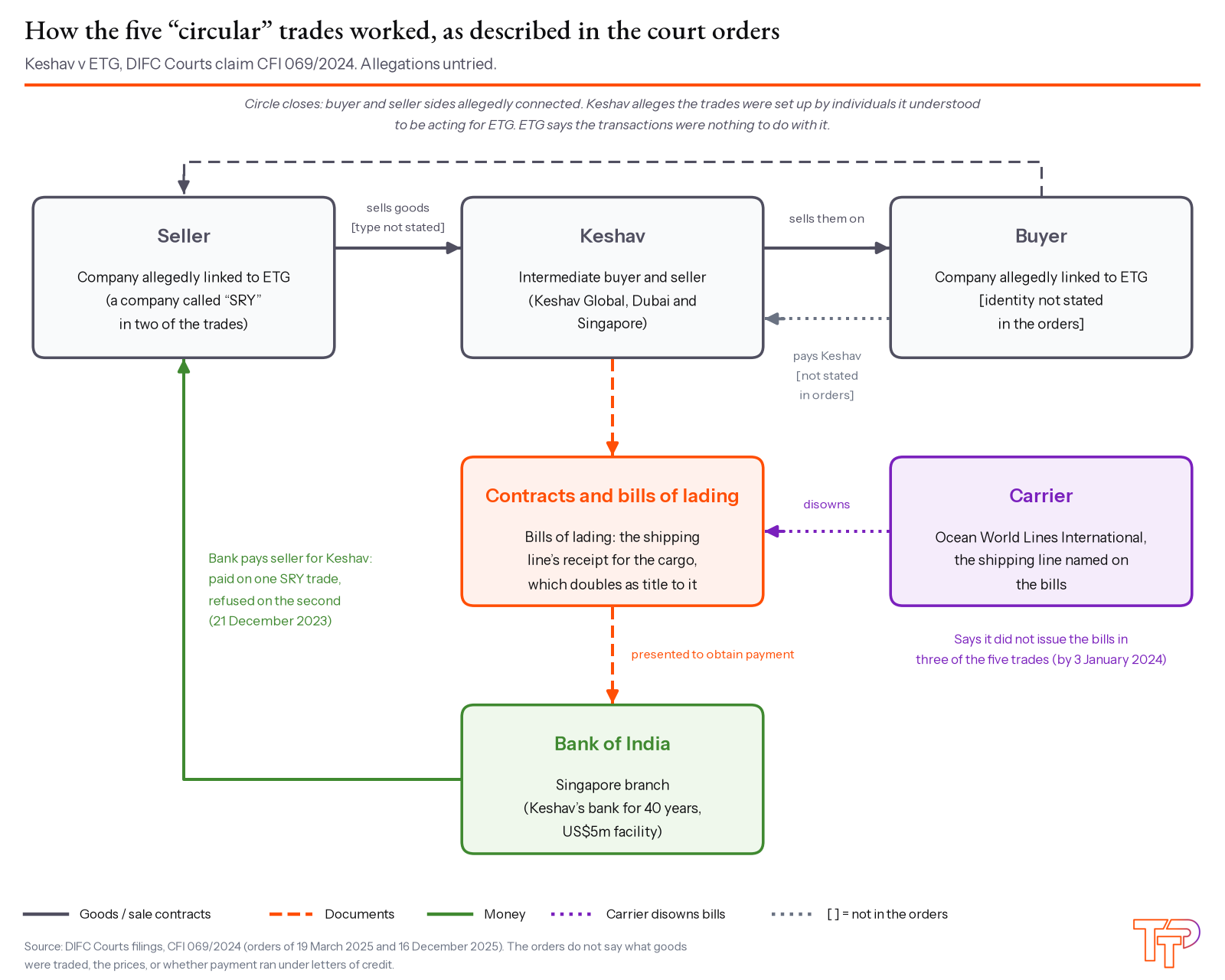
Graphic 1: How the five circular trades worked
To get Bank of India in Singapore to pay a seller, Keshav presented the trade documents, including bills of lading – the receipt a shipping line issues for cargo, which also serves as title to the goods. For the trades that went through, the judge said, the same bills “would have been utilised in both the Claimants’ purchases and onward sales”.
The orders do not say what was traded or for how much.
On Keshav’s own case, the judge noted, the trades were not “negotiated and concluded at arm’s length as real commercial transactions but were arrangements made on their behalf where the Claimants were said not to be exposed to risk”. Yet trades 1, 3 and 5 appear to have lost money, “which does not readily fit with the rationale given”.
“Not traceable on line”
It unravelled the week before Christmas 2023. On 21 December, Bank of India in Singapore told Keshav that bills of lading presented for an earlier payment “were not traceable on line and their authenticity was in doubt”.
On a call, a bank manager went further, Garg told the court: the bills of lading “appeared to be forged in both transactions with SRY as sellers”. SRY was the seller on both trades. Garg told the court the sellers were part of the ETG Group; the documents give no fuller name. The bank refused to pay on the second SRY trade.
By 3 January 2024, Ocean World Lines International, the shipping line named on the bills of lading, had confirmed that a number of bills of lading “apparently issued by them had not in fact been issued by them in relation to 3 of the 5 trades”. Keshav says they were forged. Who was behind them has not been decided.
Keshav put its forgery allegation to ETG in writing. On 18 January, ETG replied that the transactions were “nothing to do with it”.
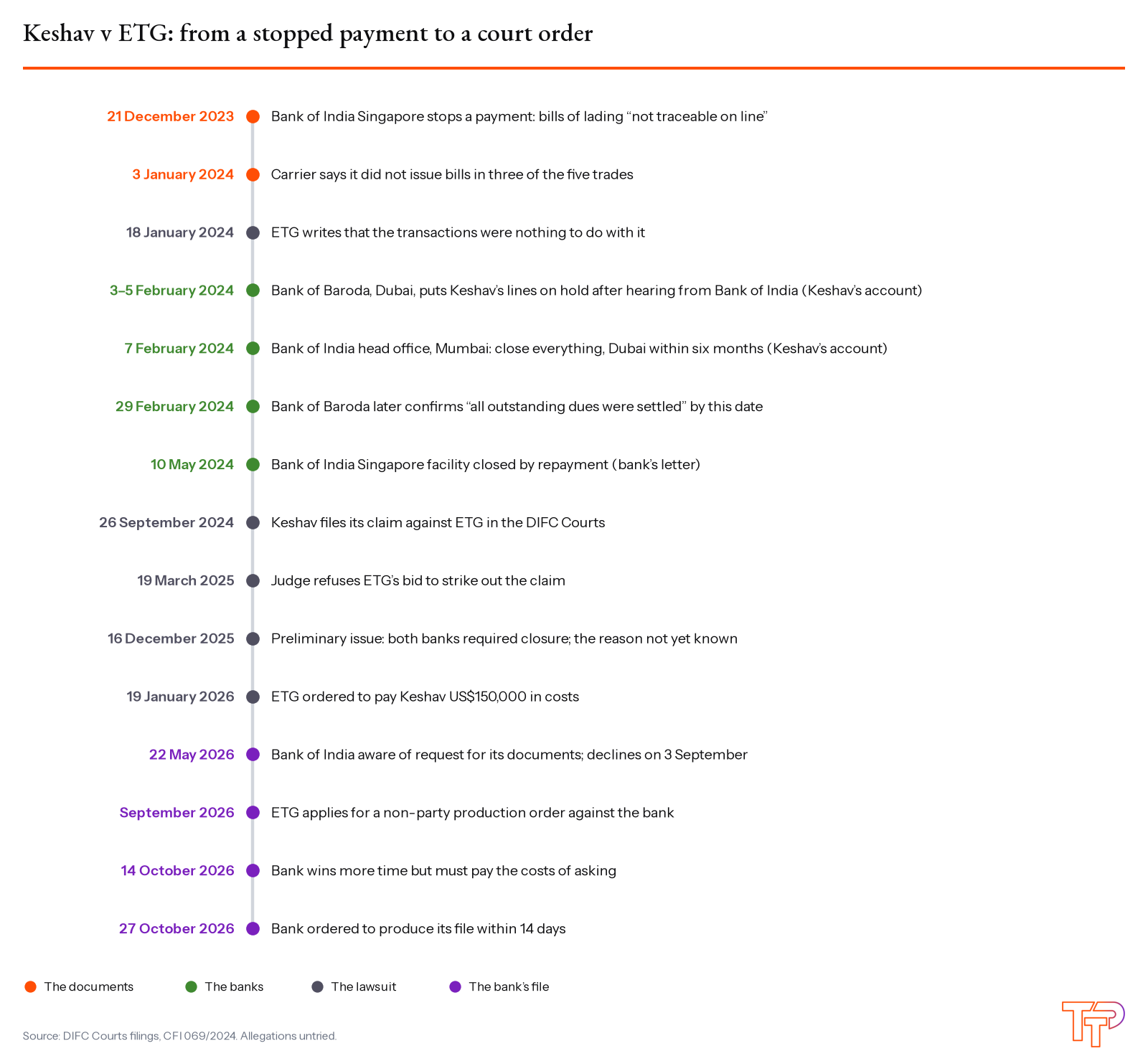
Graphic 2: From a stopped payment to a court order
Two banks walk away
Keshav had three sets of lines, all “repayable on demand”. Bank of India lent US$5m to the Singapore company and US$4m in working capital – a rolling line for day-to-day trading – to the Dubai company.
Bank of Baroda’s Deira branch in Dubai provided a US$650,000 trust receipt facility, under which the bank pays for goods and the trader holds them for the bank until they are sold, and an AED 2.7m demand loan, which the bank can call in at any time.
Word travelled between the two state-owned Indian banks, according to Garg’s evidence, which the judge accepted. In early February 2024, Bank of Baroda put its lines on hold.
On 7 February, Bank of India’s head office in Mumbai told Garg that, because of the long relationship, it “had decided not to initiate any legal or regulatory action”, but he had to clear everything. Singapore had to close at once. Dubai got up to six months, “with prior verification of every Bill of Lading”.
Bank of Baroda later wrote that the lines closed “at the instance of the bank” after events that led to “compliance related reviews and restrictions initiated by the concerned banks”.
The knockout blow that missed
Keshav filed its claim in September 2024, alleging “deceit, fraud, breach of contract and breach of duty as agents and fiduciaries”. Its losses include at least US$5.04m in lost investments, according to a ruling in March 2025. That ruling threw out ETG’s bid to strike the claim out as “misconceived in the circumstances and doomed to fail”.
ETG then asked for a preliminary issue – one question decided early – on whether the banks closed the lines because of the disputed bills of lading. If not, most of the claim fell away. ETG thought it “could constitute what amounted to a knockout blow if decided in its favour”, the judge said.
It missed. The court found the banks forced the closures: “Answer: Yes. Both Banks so required.” On why, it could not say. “The evidence before the Court does not permit of a conclusion on this point at this stage of the proceedings.”
The banks’ letters were “a little Delphic”, the judge wrote, and the trades themselves might worry a lender: “a Bank might be concerned about them regardless of any fraud”. In January 2026, the court ordered ETG to pay Keshav US$150,000 in costs.
Opening the bank’s file
That left one obvious witness. The court’s rules let a party seek a production order against a non-party – someone outside the case.
Bank of India knew of the request from 22 May 2026 and declined on 3 September, according to the court. It then won extra time but had to pay for asking, having “achieved its objective without the existence of any good reason”.
“Whether or not it took legal advice on this is not known, but a responsible Bank should have done so,” the judge wrote.
The 27 October order, “largely” agreed, reaches back to 1 January 2023. It covers the bank’s findings on Keshav’s bills of lading, its reasons for closing the lines and instructions “to exit all accounts held by the Claimants”, plus messages to Bank of Baroda on “Regulatory compliance issues” and “The Claimants generally” – the two items the bank fought, and lost.
Nor is the search limited to Dubai. “BOI DIFC appears to be a branch of BOI rather than a separate entity in any event,” the judge wrote. Separate branch databases are “not determinative”.
De-risking decisions can now end up in court
Banks close accounts all the time and rarely explain why. Bank of Baroda’s letters spoke only of “compliance related reviews and restrictions”. This order means a bank’s reasons, and what it told another lender about a client, can be read by the other side in a fraud case. That should change how banks write such notes, and how freely they share concerns about customers.
For traders, the practical lesson is about structure. A circular deal can cost a company its banking lines even where it says it did nothing wrong.
A closed credit line need not be the end of the story, though. In the DIFC at least, a bank’s reasons can be pursued through the court even when the bank is not a party.