

Bush House Agreement:Draft Articles of Productive Security
Live Updates
The Future of Security Conference, hosted by King’s College London’s Economic Competition and Conflict Research Group and the Centre for Economic Security, resulted in the adoption of the Bush House Agreement and Draft Articles of Productive Security.
This framework, released for consultation in July 2026, outlines a vision for enhancing economic security by creating interconnected ecosystems that promote resilience, preparedness, and lasting prosperity.
The agreement acknowledges the global economy as a strategic domain including defence, climate, food, water, energy, competitiveness, finance, and civil society. It recognises economic security as a contested foundation of national security, democratic resilience, and sustainable prosperity.
Article I: Security through productive capability
Economic security is defined as a society’s ability to create, sustain, and adapt productive capacity underpinning prosperity, resilience, preparedness, and national security.
Article II: Growth through resilience
Investing in resilience is framed as a boost to productivity, innovation, competitiveness, and long-term growth, making economic security a productive investment instead of just a defensive expense.
Article III: Connected ecosystems
Economic security requires integrated ecosystems linking government, finance, industry, technology, academia, and civil society around shared strategic objectives.
Article IV: Strategic visibility
Better visibility into supply chains, financial systems, technologies, critical infrastructure, and dependencies is crucial for anticipating risks, preparing effectively, and making informed decisions together.
Article V: Mobilising capital
Financial systems should reward productive investment and recognise preparedness as a strategic goal.
Article VI: Innovation and adaptation
Economic security relies on building new capabilities while protecting trusted markets, democratic values, and competitiveness among allies.
Article VII: Preparedness
Governments, industry, and financial institutions should collaborate to build productive capability proactively, recognising its role in resilience and prosperity.
Article VIII: Democratic resilience
Policies should strengthen trust by delivering tangible benefits and ensuring active societal participation in resilience-building.
Article IX: Allied prosperity
Shared capabilities, coordinated investment, resilient supply chains, collaborative innovation, and open markets form the foundation for security and prosperity.
Article X: Continuous learning
The Bush House Agreement commits to continuous collaboration and strengthening of productive capability.
Implementation of the agreement
The conference agreed that these Articles need to be implemented through interconnected economic security systems that combine public and private resources for common goals.
These ecosystems will evolve with changing technologies, markets, and geopolitical contexts.
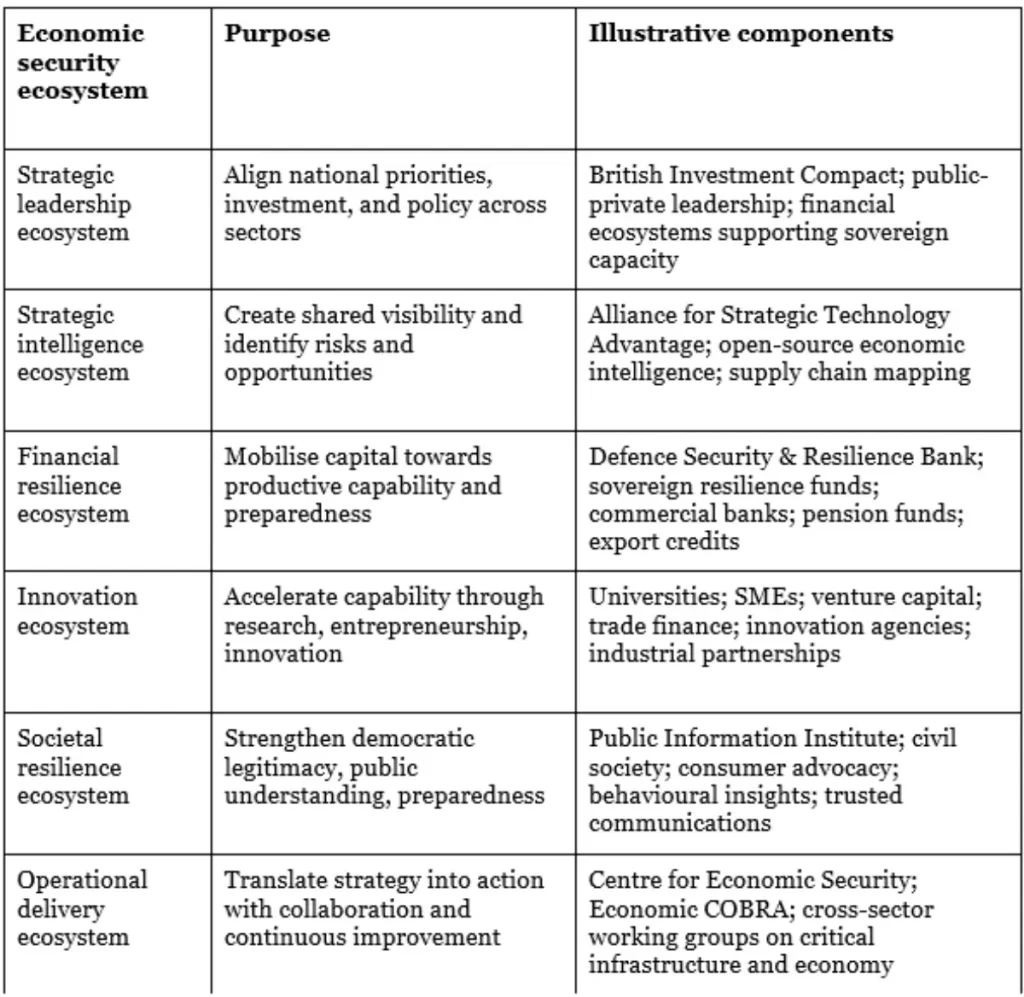
The Centre for Economic Security will independently oversee the Bush House Agreement by bringing together partners, promoting ecosystem development, encouraging collaboration, tracking progress, and publishing implementation assessments.
The Agreement belongs to a broad community of governments, businesses, financial institutions, researchers, civil society, and international partners committed to its evolution.
The Bush House Agreement embodies a shared understanding that the security of open societies depends not only on defence capabilities but also on the capacity to build productive, innovative, and resilient economies.
The goal is to create a common framework that improves preparedness, encourages productive investment, and promotes long-term prosperity, without adding unnecessary bureaucracy. This is the main principle of Productive Security.